This is the final article in our series on how Robert Cialdini’s persuasion principles show up in modern ecommerce UX. If you’re joining mid-series, you can browse all parts here: Magenable blog (series list).
The previous part, Part 6: Liking, is here: Cialdini in Ecommerce — Part 6: Liking .
Series quick links:
- Part 1: Social Proof
- Part 2: Authority
- Part 3: Scarcity
- Part 4: Reciprocity
- Part 5: Commitment & Consistency
- Part 6: Liking
- Part 7: Unity (this article)
Unity is the “we-ness” principle: people are more likely to say “yes” to brands they feel they belong with — not just brands they like. Where “Liking” can be surface-level preference, Unity is identity-level connection: “this is our brand / our people / our place.”
Unity also amplifies other persuasion principles:
- Social proof is more credible when it comes from “people like us”.
- Scarcity feels more meaningful when it’s “our limited drop”.
- Reciprocity feels more personal when it’s “we take care of our community”.
1) Identity-based unity (who we are)
Unity starts with making it obvious who the brand is “for” and showing proof that it’s real. Identity can be based on:
- Profession / hobby / lifestyle (runners, tradies, pet parents, home cooks)
- Locality (suburb/city/state/national identity — often the safest bet)
- Culture / faith / politics (race/ethnicity, religion, political affiliation) — possible, but use with caution
A note on sensitive identity signals (use with caution)
Brands sometimes build community around religion, ethnicity, or political identity. That can create strong unity, but it can also feel exclusionary, polarising, or simply irrelevant to the product. If you go near these make sure the message matches your actual audience.
Pattern: locality as identity (“our place”)
Locality is a clean unity lever because it creates an immediate shared anchor: “we’re from the same place” — and often “we support the same community.”
Approach 1: “Your local …” framing + operational proof
This works best when you can back it up with service coverage and real operational cues (delivery zones, click & collect, staff/picking language, local suppliers).

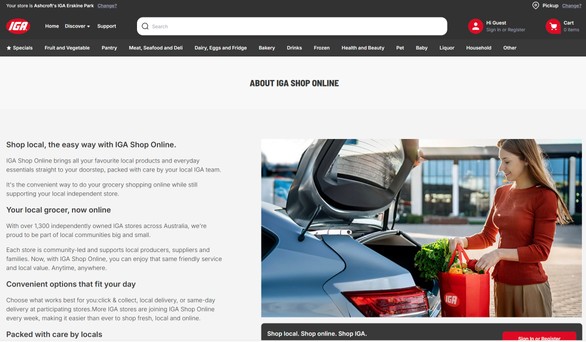

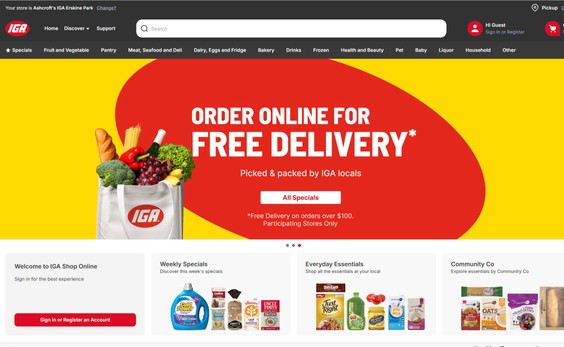
IGA website – locality-based identity at the top of the funnel: “picked & packed by locals”
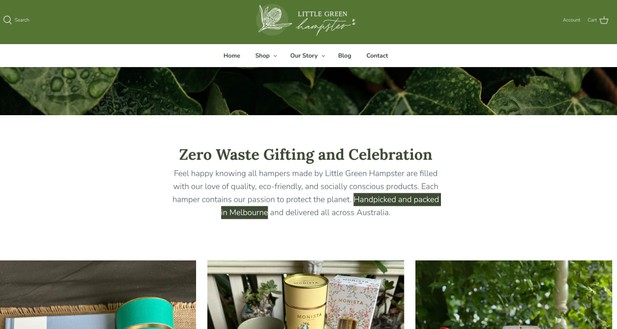
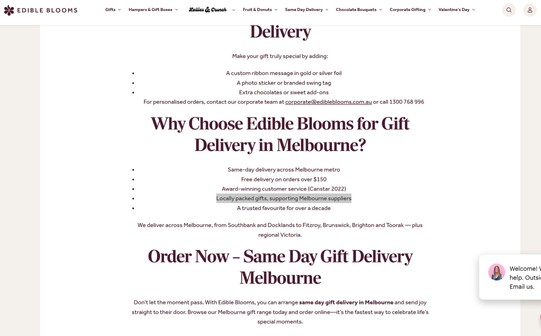
Approach 2: “Packed in [city]” (a softer but credible locality cue)
If suburb-level identity is too narrow, “packed in Melbourne / packed locally” is often a low-drama way to make “place” real. It also reduces scepticism because it’s operational (not vibe-based).


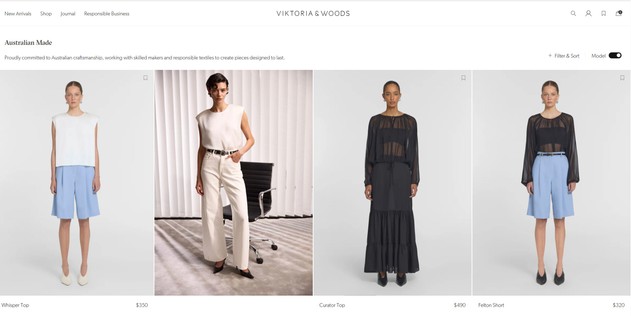
Approach 3: Australian-made / Australian-owned cues
National identity cues can be powerful, but they must be precise. “Made in Australia” ≠ “Australian designed” ≠ “Australian owned”. Use badges only where the claim is true, and ideally support it with an explainer page and filters.

2) Participation and co-creation (identity you can see)
Identity becomes Unity when customers can participate, not just buy. This is where “community” stops being a tagline and becomes behaviour.
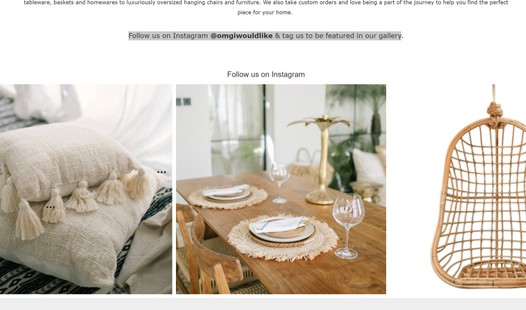
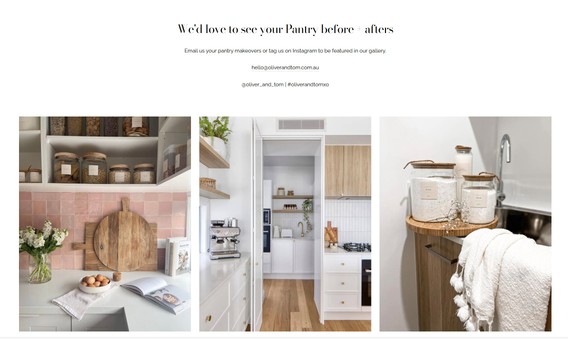
Pattern: “tag us to be featured” (UGC as participation)
A simple, screenshot-friendly unity mechanism is inviting customers to share their results and be featured. It creates a low-friction loop: buy → use → share → get featured → belong.


Watch-out: fake participation backfires
“Vote on the next drop” when nothing changes, or a “community” page that’s just influencer photos, kills trust. If you invite participation, make the outcome visible.
3) Membership framed as belonging (not points)
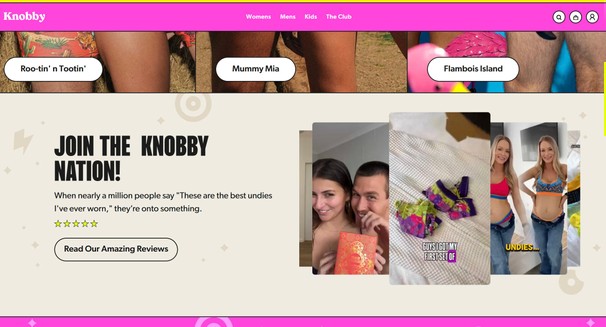
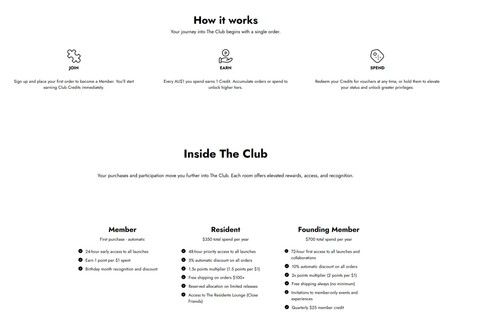
Loyalty programs perform better when they feel like joining something, not collecting coupons. The language matters: “members” implies belonging; “points” implies transactions.
Pattern: name it like a club (and make the benefits feel inside-baseball)
Strong membership pages typically include: a welcome headline, simple explanation, and benefits that feel like access (early drops, priority windows, member-only products/events), not just discounts.


Watch-out: don’t call it a club if it’s only discounts
If the program is essentially a coupon engine, label it honestly. “Club” language raises expectations for access, recognition, or participation.
4) Shared rituals (do something together)
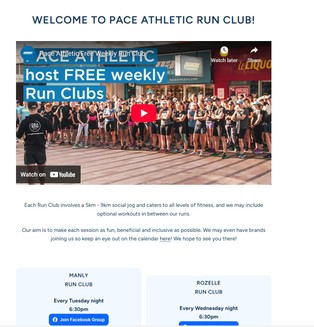
Unity strengthens when there are shared activities: weekly clubs, seasonal routines, launches, drops, and events. You don’t need a huge budget — one repeatable ritual can shift you from “store” to “community”.
Pattern: recurring run clubs (weekly ritual)

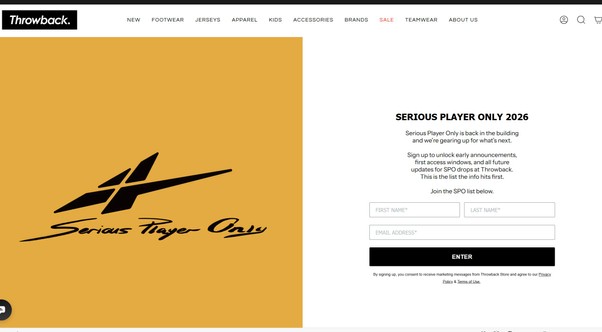
Pattern: drops + early access (ritualised scarcity for the in-group)
Drops become rituals when customers can anticipate a schedule and membership ties directly to access (“members first”, “priority window”).

Anti-patterns that kill Unity
- Claiming “local” while fulfilment is clearly non-local.
- Flags/badges that imply “made here” when only “designed here”.
- “Community” with no real participation (or only influencer content).
- Forced slang/voice that doesn’t match your audience.
- “Vote” mechanisms where nothing ever changes.
Implementation checklist (1–2 sprints)
- Write the identity line. “We’re for ___” (specific enough to exclude someone).
- Add one unity cue above-the-fold. “By X, for X” or locality (“picked & packed by locals”, “packed in Melbourne”, etc.).
- Add one participation mechanism. Gallery, challenge, feedback loop, or collaboration that’s real.
- Make membership feel like joining. Rename/reframe benefits + create a “welcome” onboarding moment.
- Create one ritual. A repeatable drop schedule, weekly club, seasonal kit, or live event.
- Make proof visible. Coverage maps, supplier proof, member galleries, certifications, or behind-the-scenes ops cues.
What to measure
- Member sign-up rate (before/after).
- Repeat purchase rate + time-to-second purchase (cohort-based).
- Referral/share rate (codes, UGC tagging, “send to a mate”).
- Conversion rate of identity-led landing pages vs generic category pages.
- Returns/support signals (to ensure identity claims match reality).